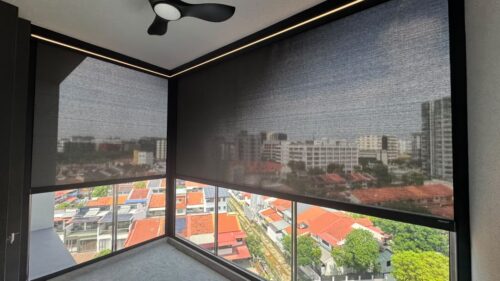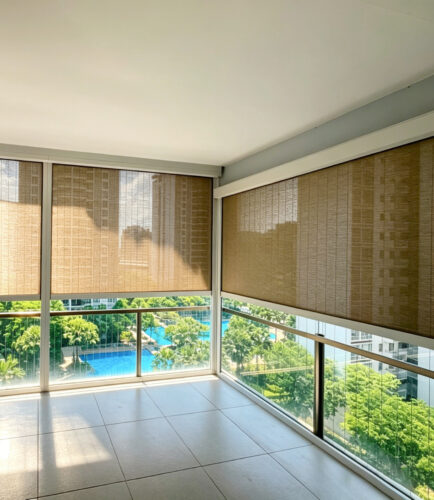
Most problems with zip blinds fall into two areas.
The first is fabric appearance: zip blind creasing, zip blind wrinkles, waves, uneven-looking fabric or a perceived loss of fabric tension.
The second is long-term performance: how the blind copes with repeated operation, outdoor exposure and the condition of its tracks, motor and other moving parts.
Motor, control and maintenance issues can occur too, but this article focuses on two concerns homeowners often associate with outdoor and balcony zip blinds: how the fabric behaves over time and how reliably the blind continues to perform.
Why Can Zip Blinds Develop Creases or Wrinkles?
A crease can have more than one influence.
Fabric tension, repeated rolling, fabric characteristics, blind dimensions, track design, alignment, outdoor exposure and time spent rolled up can all affect what a homeowner sees when the blind is lowered.
A gentle wave is not necessarily the same thing as a permanent crease. A blind that has remained rolled up may need some time to settle after being lowered. In mc.2’s own MAGNAZip+ guidance, we acknowledge that minor waves can be a natural characteristic of the fabric and that minor creases may sometimes appear when the fabric is new or has remained rolled up for an extended period.
In other words, wrinkled zip blinds are not automatically defective.
Flexible fabric will not behave like glass or aluminium. The realistic question is whether the fabric returns to an acceptable, stable appearance during normal use.
Persistent or increasingly obvious changes are different. If a blind repeatedly sits unevenly, shows a noticeable change in tension or no longer tracks as expected, its tension, alignment, system design or installation may deserve closer attention.
Why Does Fabric Tension Matter?
Fabric tension helps support the screen across the width of the opening.
Appropriate lateral fabric tension can contribute to a neater, more stable appearance when the blind is lowered. A change in tension may become visible even while the blind continues to raise and lower normally.
That is why mechanical operation and fabric appearance should not be treated as the same measure of zip blind performance.
Why Can Creasing Become More Noticeable Over Time?
Day-one appearance tells only part of the story.
A zip blind is repeatedly rolled onto and off a tube. Fabric behaviour during that process matters. Phifer, an established solar-screen fabric manufacturer, for example, specifically develops certain shade fabrics to reduce their natural tendency to track while being rolled and to help them roll straighter.
This does not mean repeated rolling automatically causes creases. It shows why the way flexible fabric behaves through repeated operation is a legitimate long-term consideration.
For zip blinds in Singapore, outdoor exposure can also mean strong sunlight, heat, wind and rain. None of these conditions automatically creates a crease, but together they form the environment in which the blind has to operate.
How Durable Are Zip Blinds?
Zip blinds can be durable outdoor shading systems, but zip blind durability is broader than whether the blind still opens and closes.
Long-term performance can be observed in several different ways:
- Operation: Does the blind continue raising and lowering consistently?
- Appearance: Does the fabric continue to sit acceptably when lowered?
- System condition: Are the tracks, fixings and moving components functioning properly?
Reliability: Does the system continue behaving consistently through regular use and outdoor exposure?
Durability can be influenced by track and retention design, fabric, tension management, motor and moving components, installation quality, frequency of use and the conditions around the opening. Exterior screen fabrics also differ in their construction and intended applications; fabric manufacturers publish specific products designed for exterior roller-shade use.
This is why durable zip blinds should not be interpreted as blinds that never change visually or never require attention.
A better measure is whether the blind has been designed, specified and installed to continue performing through repeated real-world use.
Can Zip Blinds Withstand Strong Wind?
Zip blinds can be designed for wind exposure, but zip blind wind resistance is not one universal rating that applies to every product or every installation.
Performance can vary according to the size of the blind, fabric, side-track design, mounting structure, installation, configuration and how exposed the opening is. A blind installed on a sheltered balcony may experience very different conditions from one installed on a highly exposed façade.
This is why wind-performance claims are more useful when they are backed by controlled testing rather than a wind-speed number alone.
What Does Wind-Resistance Testing Actually Tell You?
In controlled testing, a specific blind specimen is installed in a defined configuration and subjected to stated pressure conditions.
The result should therefore be read together with details such as:
- the product or specimen tested
- its size or area
- the test method
- how the blind was operated
- the pressure applied
- the observations recorded after testing
Laboratory testing provides evidence of how that particular specimen performed under those stated conditions. It should not automatically be treated as a guarantee that every blind of every size will perform identically in every real-world weather condition.
How Was MAGNAZip+ Tested?
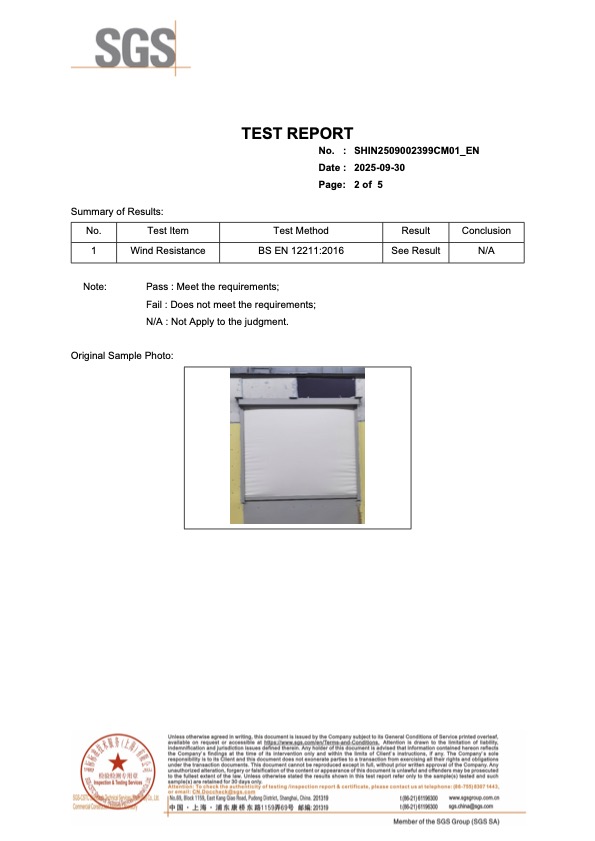
MAGNAZip+ has undergone third-party wind-resistance testing by SGS.
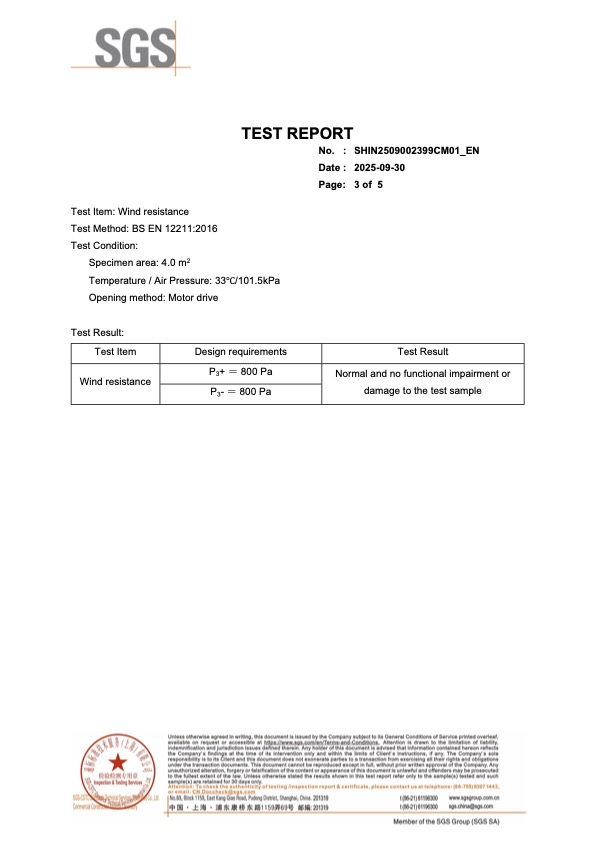
According to SGS Test Report SHIN2509002399CM01_EN, dated 30 September 2025, the wind-resistance test was conducted using BS EN 12211:2016.
The report identifies:
- Test item: Wind resistance
- Specimen area: 4.0 m²
- Opening method: Motor drive
- Test conditions: 33°C and atmospheric pressure of 101.5 kPa
- Positive pressure requirement (P3+): 800 Pa
- Negative pressure requirement (P3−): 800 Pa
Under those stated test conditions, SGS recorded the result as:
“Normal and no functional impairment or damage to the test sample.”
That is the most useful way to interpret the result. It demonstrates how the tested specimen behaved when subjected to both positive and negative pressure conditions of 800 Pa.
It should not be interpreted as a universal wind guarantee for every MAGNAZip+ installation. Actual performance at a home can still be affected by blind dimensions, mounting conditions, building orientation, exposure, wind direction and installation.
For that reason, we would not convert the 800 Pa result into a blanket claim such as “withstanding 130 km/h winds” unless that wind-speed interpretation is specifically supported by the relevant test methodology.
Are Fabric Stability and Durability Connected?
Fabric stability and overall durability can be related, but they are not the same thing.
A visible wave or crease does not automatically mean the blind has structurally failed. A blind can remain operational while its fabric appearance changes.
Likewise, a smooth-looking screen does not tell you everything about the condition of its motor, tracks, fixings or other components.
Long-term zip blind performance therefore involves several dimensions: appearance, fabric stability, tension, operation, component reliability, installation and resistance to the surrounding environment.
How a system manages fabric tension through repeated operation is one consideration within that bigger picture, and not a standalone definition of durability.
What Should Homeowners Look for to Reduce These Problems?
The best way to reduce uncertainty is to look for evidence that the system has been designed around the problems that actually matter to you.
For fabric appearance, that means understanding the tensioning approach, track design and expected fabric behaviour. For durability, it means considering components, installation, suitability for outdoor use, servicing support and meaningful performance testing where available.
At mc.2, MAGNAZip+ was developed around one recurring concern we see with outdoor zip blinds: maintaining fabric tension over time.
MAGNAZip+ uses a magnetic tensioning system designed to help maintain lateral fabric tension and support a more stable fabric appearance. Our own product guidance still recognises that temporary minor waves or creases can occur under certain conditions; the objective is to manage flexible fabric more effectively, rather than pretend it can never move.
The same evidence-led approach should apply to durability and wind claims.
A smooth showroom sample tells you what the blind looks like today. Testing, system design and real-world engineering tell you more about what the product has been designed to cope with afterwards.
Understanding that distinction makes it easier to recognise normal temporary fabric behaviour, identify changes worth investigating and evaluate the long-term performance of a zip blind without assuming that every wrinkle, wave or movement represents failure.