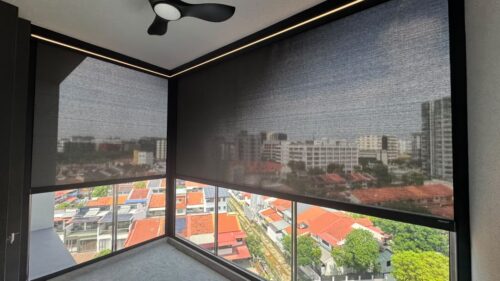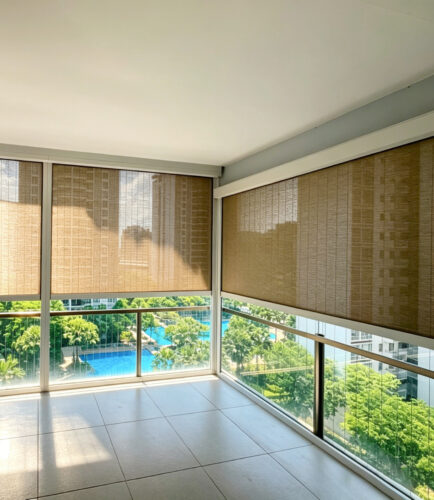
A durable zip blind depends on the complete system: outdoor-suitable fabric, controlled tension, well-built tracks and hardware, an appropriate motor, correct installation and ongoing care. No single component can guarantee how long it will last.
For Singapore homeowners, durability means more than looking good in a showroom. Your balcony blinds need to cope with repeated use and the conditions at your home.
At mc.2, we encourage you to ask how a blind is built, how it will be fitted and how it can be maintained. These questions reveal more than a price tag alone.
1. Fabric Designed for Outdoor Exposure
The fabric is the largest visible part of a zip blind, and it faces sunlight, moisture and regular rolling.
Prolonged UV exposure can affect outdoor materials, contributing to fading and deterioration. Choosing a fabric intended for exterior use is therefore an important starting point.
However, UV blockage and UV durability describe different things. Blocking sunlight from reaching your balcony does not, by itself, prove how well the fabric resists ageing.
Ask about the fabric’s composition, suitability for outdoor use, resistance to fading and care requirements. Thickness can be relevant, but it should be assessed alongside construction, flexibility and compatibility with the blind system.
Our advice: Request the fabric specifications rather than judging durability by how heavy a sample feels.
2. Controlled Fabric Tension
A zip blind needs enough support to keep its fabric stable, while allowing the movement expected of a flexible outdoor screen.
Uneven or insufficient tension can contribute to sagging and visible distortion. Equally, pulling fabric as tightly as possible is not a universal solution; the system must accommodate wind pressure without unnecessarily stressing the material.
At mc.2, our MAGNAZip+ approach combines magnetic technology with a tension coil mechanism to help maintain fabric tension. This addresses an important part of long-term appearance: how the fabric is supported after installation.
Our advice: Ask how the system manages tension, and whether its appearance changes at different operating positions.
3. Tracks, Frame and Hardware That Work Together
The fabric gets most of the attention, but the components around it matter too.
Side tracks guide the screen, while the frame, bottom bar and fixings form part of the supporting structure. Their material, alignment and connection to the building all deserve consideration.
For outdoor installations, ask what the profiles and fasteners are made from and how their finishes suit the environment. “Aluminium frame” is a starting description, rather than a complete explanation of build quality.
For example, our MAGNAZip specifications identify the aluminium grades used in its headrail and exterior profiles, alongside a powder-coated finish.
Our advice: Compare the complete hardware specification, including fixings, rather than only the visible frame.
4. Wind Performance Supported by Testing
Wind resistance is relevant to balcony blinds, particularly where the opening is exposed.
Our MAGNAZip+ system has undergone wind testing by SGS under controlled conditions. Such testing provides useful evidence, but homeowners should also ask which panel dimensions, configuration and installation conditions the results apply to.
A laboratory result should not be treated as permission to operate a blind in every storm. Follow the operating guidance for your specific system.
Our advice: Ask for the applicable test information and how it relates to the blind proposed for your balcony.
5. A Motor Suited to the Screen
For motorised zip blinds, the motor should suit the application and the screen it moves.
Consider the motor model, its suitability for exterior screens and the protection functions available. For example, selected Somfy Maestria motors offer obstacle detection for compatible zip screens, helping protect the fabric and guides when an obstruction is detected.
These features depend on the motor and setup. They do not remove the need to keep the blind’s path clear or address resistance during operation.
Our advice: Ask which motor is included, what its protection functions do and who handles servicing.
6. Accurate Measurement and Installation
Even a well-designed blind needs a suitable installation.
Measurements, frame alignment and correct fabric seating affect how the screen travels through its tracks. An uneven frame or incorrectly seated edge can contribute to folds and operating problems.
Balconies also differ. Uneven floors, drainage points and irregular openings may require a different installation approach. At mc.2, we recommend a site assessment to establish how the proposed system can fit the space.
Our advice: Choose a provider who explains the installation method for your actual balcony, including any limitations identified during measurement.
7. Maintenance and Everyday Use
Durability depends partly on what happens after installation.
Follow the cleaning instructions for your fabric and system. Generally, this means using suitable gentle cleaning methods, keeping tracks clear and allowing the fabric to dry before rolling it up after cleaning, where specified.
Avoid forcing a blind that catches or repeatedly stops. Seek advice if its movement changes rather than continuing to operate it through resistance.
For MAGNAZip+, we recommend regular cleaning and periodic servicing of the motor, tracks, magnets and moving components.
Our advice: Obtain the care guide at handover and ask when servicing is recommended for your exposure and usage.
8. Clear Warranty Terms and Accessible Support
A warranty helps you understand the support available if something goes wrong. Its duration alone does not establish the blind’s durability.
Before purchasing, ask which parts are covered, whether labour and transport are included, what exclusions apply and how a service request is handled.
Also ask whether individual components can be repaired or replaced. A serviceable system may offer a more practical ownership experience when one part needs attention.
Our advice: Compare the written terms and service arrangements alongside the product specifications.
Frequently Asked Questions About Zip Blind Durability
Does thicker fabric always mean a more durable zip blind?
No. Thickness is one consideration. Fabric construction, outdoor suitability, rolling behaviour and compatibility with the complete system also matter.
Do wrinkles mean a zip blind is wearing out?
Not necessarily. Temporary waves can appear after storage or during wind. Persistent creases or changes in operation should be assessed.
How long should a durable zip blind last?
There is no single lifespan for every installation. Exposure, usage, materials, installation and maintenance all affect how the components age.
Choose Zip Blinds With Long-Term Performance in Mind
At mc.2, we want you to understand what you are choosing, from fabric and tension technology to installation and after-sales care.
See the difference for yourself at our showroom.
Visit us at Vertex, 33 Ubi Ave 3, #01-28/29, Singapore 408868. Walk-ins are welcome.
For a free estimate, send us a balcony photo, floor plan or measurements. Our team will help you explore MAGNAZip+ for your home.